
The Marne Valley
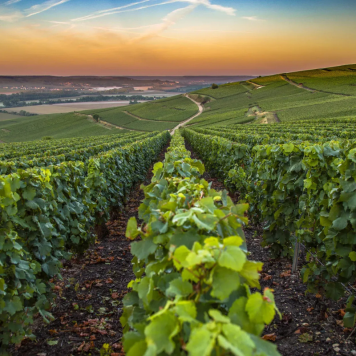
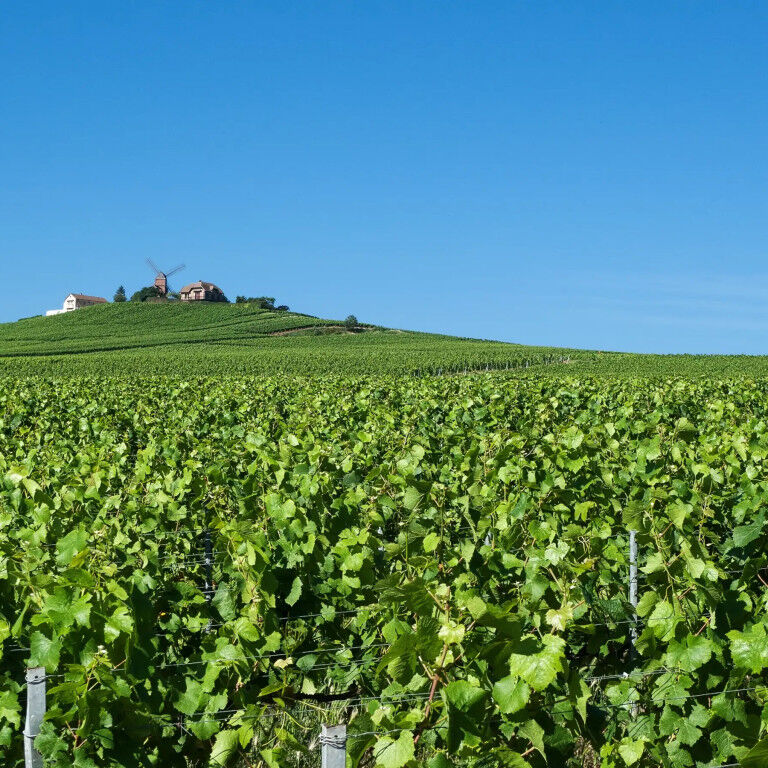
Situated between Epernay and Château-Thierry, the Marne and its tributaries form hillsides that are ideal for growing vines, on limestone subsoil from the Paris Basin and on chalk over more than 80 kms. The south-facing, well-exposed slopes are the best for planting Meunier and Pinot Noir grapes.These are the stars of the Valley.
A tourist route from Avenay-Val-d'Or to Épernay (approx. 90 km) allows you to meet the winemakers and Champagne houses.
The poet Pierre de Ronsard even wrote a poem about it:"I came near the ileuse Marne, Not far from the place where its waters, With a forked arm press the walls of Meaux, Meaux of which Bacchus soigneux has taken the guard, And with a good eye its hills looks... Not only Bacchus favors them, but his companion and the shepherd of Anfrise, one making the ears of corn blond, the other greening the herbs in abundance".
Champagne from the Marne Valley?
The Marne Valley is a breeding ground for talented winemakers, and there are some wonderful discoveries to be made here, such as the Maisons Jacquessonand Laherte Frères.Champagne houses such as Krug and Laurent Perrier also own vineyards here.
The Montagne de Reims
The terroir of the Montagne de Reims is the largest of all Champagne terroirs. It is a small mountain whose highest point is 286 meters above sea level. Some of the vines are planted with Chardonnay, but it's the heart of the Pinot Noir appellation.œur du Pinot noir with 60% of the planted area. The 9,000 hectares of vines planted on the slopes of the Montagne de Reims are not the only ones to cover its landscape. Forests cover a large part of the high plateau.It also acts as a thermal regulator for the vines. The chalky mountain slopes where the vines are planted face north.In the evening, the cold air descends towards the plain, and the warm air that has formed over the Montagne de Reims during the day descends onto the vines.This is the region with the most villages classified as Grand Cru.
To thewest lies the Petite Montagne area. It's no smaller, but its name comes from the fact that its wines are of average quality, at the lower end of the crus scale.
Montagne de Reims champagnes? .
Pinot noir offers wines with strong, well-supported characters, powerful and racy.Their aromas are fine, with notes of red fruit.Wines from the northern part are often fuller-bodied and darker than those from the southern part.
Côte des Blancs
This is undoubtedly the Champagne region whose terroir is best suited to producing Grands Crus. It is made up of an essentially chalky terroir, known as "chalky champagne", hence the name "Blancs", on whichChardonnay thrives and which accounts for 97% of the area's plantings. The Côte des Blancs region boasts a beautiful wine route stretching from Épernay to Vertus . The Côte des Blancs villages classified as 100% Grand Cru are Avize, Chouilly, Cramant, Mesnil-sur-Oger, Oger and Oiry.
Côte des Blancs champagnes?
They have great aromatic finesse and outstanding structure. They are fresh, bright and clear. Several major Champagne houses have plots here. Maison Bollinger owns vineyards on the Côte des Blancs for the production of its Cuvées de Prestige. Maison Roederer, too, for its vintage Blancs de Blancs champagne. Krug's"Le clos du Mesnil" is a vintage Blanc de Blancs parcel cuvée, planted in Mesnil-sur-Oger since 1698. A little gem of a champagne, from a single vineyard, a single grape variety and a single harvest. This champagne is one of the most sought-after in the world.
The Côte des Bar
This is the southernmost part of the Champagne vineyards, with some 2,519 growers. Located between Bar sur Aube and Bar sur Seine, a hundred kilometers south of Epernay, the Côte des Bar is 84% dominated by Pinot noir.Here, it is much rounder and lighter than the Pinot Noir of the Montagne de Reims.The southeast-facing soils on which they grow are made up of hard limestone and marl.
Côte des Bar champagnes?
They are mineral and iodized, with scents of smoky limestone and red and black fruits. They are often used by the Grandes Maisons to enhance the freshness of their cuvées.