Cyril Brun, how long have you been employed by Maison Charles Heidsieck?
I was asked to join the House at the end of 2014 after the tragic death of my predecessor, Thierry Roset.For the record, when I graduated, I was dreaming of two Houses: Charles Heidsieck and Veuve Clicquot.So I sent in two CVs, the only ones of my life, and it was to these two Houses.I was lucky enough to be interviewed by the two cellar managers at the time, Jacques Peters for Clicquot and Daniel Thibault.The interviews went very well, but it wasn't long before Jacques Peters said to me "Ok, the job of assistant cellar master is for you".So I started at Clicquot as an oenologist in charge of wine communication and oenological development . Little did I know that 15 years later, what was my other initial choice would come true.
You were predestined...
I come from a family of winegrower-merchants and coopers in Aÿ. So, yes, in our family history, we drank, among others, Clicquot and Charles Heidsieck. These were wines that really belonged to the family.I had a special feeling for those two Houses.
What does the job of Cellar Master mean to you?
In my eyes, it's a job for an orchestra conductor.You create a lot of things, but above all, you have to be able to take a step back and set medium- and long-term goals.The quality of a wine begins in the vineyard and extends right through to the finishing touches, such as dosage, choice of closure, oxygen management and the entire aging process.We're in the business of details and precision.
What does the Charles Heidsieck brand represent today?
Today, we've completely overhauled our distribution networks, with a fairly young team all over the world, ready to take on the business and commercial side of things.On a more personal note, I'm lucky that the wines didn't deteriorate during the House's descent into hell.I arrived in an extremely healthy and enviable situation, with an exceptional level of stock.Not only in terms of quantity, but also in terms of the quality and complexity of the wines. Imagine that the House never let go of its grape supplies, so it continued to make juice, but didn't release any bottles, so everything went into reserve wine.Today, this is a phenomenal strength for a house in the oenological sense, but we agree that from a financial point of view, it was more questionable.
What is the DNA of Charles Heidsieck champagnes?
Since I arrived, I've been working on these very elements, on the "Charles style". To have a real identity in terms of mouthfeel, fatness and bubble size, which for me was completely distinctive. We have therefore put in place elements to amplify these singularities and perpetuate the spirit and excellence of Monsieur Charles Heidsieck.
Another important element of Charles Heidsieckis time?
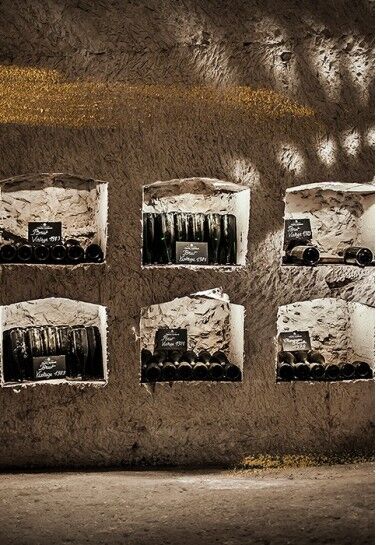
It's a fundamental element!The aging process.There are two phases to aging.Aging between your bottling date and your marketing date. On this point, the company was a pioneer, since in the 80s it put the bottling date of its wines on its labels.In this way, even a non-vintage cuvée could still be dated by the consumer.You knew whether you were dealing with a non-vintage wine that was 5, 7 or 8 years old.It was a real initiative, since at the time nobody talked about ageing times.We've kept this system.
And then there's the time factor that starts before bottling, the reserve wines.These wines represent 50% of our raw blends, and some of our reserve wines are over 20 years old.A bottle of Charles Heidsieck on the market today already has a life that began 30 or 40 years ago.Time is of the essence.It's an element of status for us!
Is there a hierarchy of wines in the Charles Heidsieck range ?
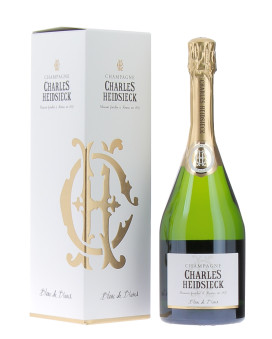
Not really.We're more concerned with profiles or drinking occasions than with a real hierarchy.Even so, our brut millésimé represents 85% of our volumes.We've also created a lot of new wines, including coteaux champenois, whites and reds, and we've put back into battle a Blanc de blanc conceived in 1949 by the founder's grandson, Charles-Marcel.