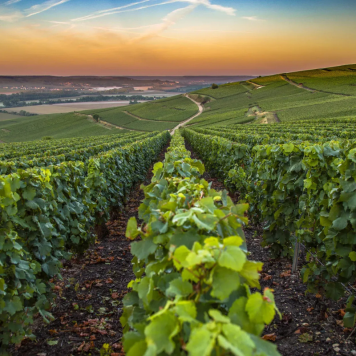
During the harvest, from late August to October, no machines are used.Harvesting is exclusively manual, to ensure that the bunches are intact and ripe.Harvesting is carried out in crates with a maximum load of 50 kg, to avoid crushing the grapes.
-Once taken to the press, the whole bunches are pressed very quickly, so as not to spoil them and to prevent the grape skin from tinting the juice too much.To give you an idea, 160 kg of grapes yield 102 liters of juice.
-This juice is then sent to the cuverie, where it ferments.The first fermentation, often very rapid, takes place at low temperature in thermo-regulated stainless steel vats.Barrels are rarely used.The result is a dry, still, fruity wine, with a slight acidity that retains the foam, and an alcohol content of around 11% vol.
- Once the first fermentation is complete, the wine is racked and fined, and then the cuvées are made. There may be a blending stage for wines from the same year, or those that may have been put into reserve in previous years. This is a stage of the utmost importance, which can perpetuate the style and consistent quality of a Champagne House. It is at this point that the cellar master composes his champagne symphony.Once the cuvée is ready, the second fermentation begins. This operation begins at the end of winter, on January 1st. Before the bottle is closed, yeast is added, followed by a liqueur de tirage to trigger the second fermentation. One kilo of cane or beet sugar per liter of old wine. Above 28 to 30 grams of sugar, the bottle will explode under the effect of pressure. This second fermentation lasts around 2 months, at a temperature of 10°C. The bottles are placed on wooden laths, and must be aged for at least 15 months after the tirage, and 3 years for vintage Champagne. In very good years, aging can last from 5 to 10 years.
- From the 8th month onwards, the yeast transforms the sugar into alcohol, and above all into carbon dioxide, which produces bubbles and foam.
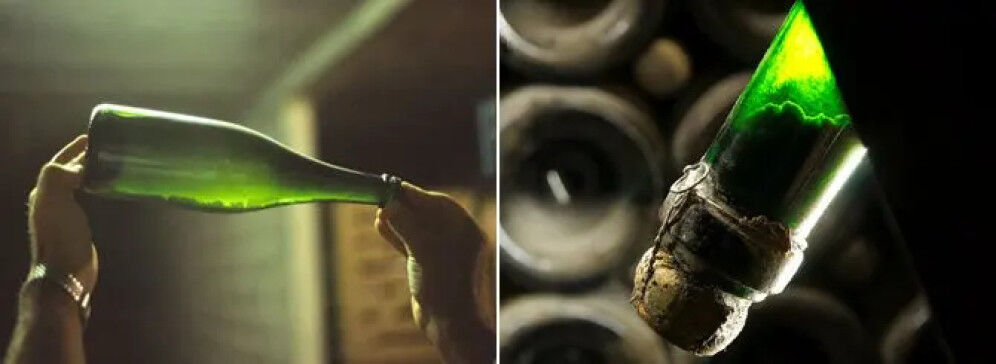
-The bottles are then placed on desks, and turned 1/8th of a turn in one direction, then the other. At the same time, the bottle is tilted more and more towards the vertical, so that the lees concentrate in the neck. Riddling lasts from two weeks to 3 months, depending on the House.
-Then comes the disgorging stage. The purpose of this operation is to expel the deposit of dead yeast.Disgorging on the fly is done with ice.The neck of the bottle is plunged into a brine bath at -24°C.The resulting ice cube traps the deposit, which is ejected when the bottle is opened.The bottle is then resealed after receiving the dosage liqueur mentioned in a previous article. A resting period of 2 to 4 months is necessary to allow the liqueur to blend harmoniously with the rest of the wine.
This is the finished méthode champenoise.