
What is champagne dosage?
The dosage is the final touch in the champagne-making process. To understand this, you need to know that each bottle of champagne undergoes a second fermentation in the bottle. This is called prise de mousse. This stage creates the bubbles thanks to the carbon dioxide produced by the yeast. Fermentation leaves a deposit in the bottle, which is gradually concentrated in the neck before being expelled: this is the disgorging process.
Once this deposit has been removed, a small space is created in the bottle. This is where the liqueur d'expédition, also known as liqueur de dosage, is added: a mixture of very pure cane sugar and reserve wines from previous harvests. This final operation is called dosage.
The amount of liqueur added, expressed in grams of sugar per liter, determines the champagne's style. Each house jealously guards the composition of its dosage liqueur: it is often a key element in the identity and personality of their cuvées. After dosage, the bottle is recorked with its cork and wire, then left in the cellar for a few more weeks before being sold.
The 7 types of champagne dosage
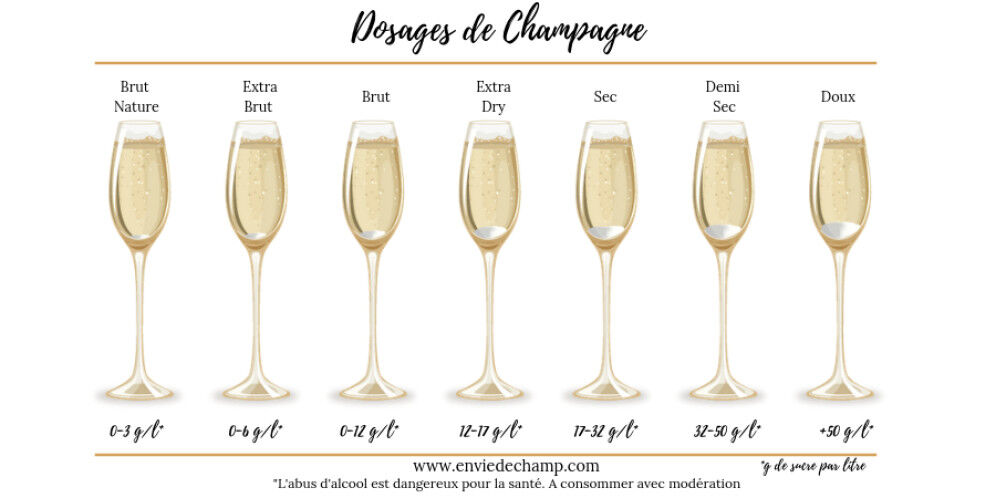
Here are the 7 levels of dosage defined by Champagne legislation, from the least sweet to the sweetest:
Champagne Brut Nature (or Zéro Dosage, Ultra Brut)
Less than 3 g/l, with no added sugar. This is champagne in its purest, rawest form. Some call it "naked" champagne, the most direct expression of terroir and winemaking.
Champagne Extra-Brut
Between 0 and 6 g/l. Very low dosage, dry and taut. The bubbles are lively, the acidity well present, and the primary aromas of the grapes are clearly expressed.
Champagne Brut
Less than 12 g/l. This is by far the most popular style, accounting for some 95% of champagne sales worldwide. Fresh, well-balanced and accessible to all palates. The Champagne Brut is a safe bet.
Extra-Dry
Between 12 and 17 g/l. Slightly rounder than Brut, with a perceptible hint of sweetness. Less common in France, it is highly appreciated in certain export markets, notably England.
Champagne Sec
Between 17 and 32 g/l. Despite its name, this champagne is sweeter than Brut. The sweetness is clearly perceptible on the palate, with a balance that leans towards fruitiness.
Champagne Demi-Sec
Between 32 and 50 g/l. A soft, generous champagne, ideal with desserts. It has been enjoying a revival in recent years, particularly for sweet and savory pairings.
Doux
Over 50 g/l. The sweetest of all, now very rare. More a historical curiosity than a consumer trend.
How does dosage influence the taste of Champagne?
This is the key question. In concrete terms, dosage affects two fundamental parameters: the balance between sugar and the natural acidity of Champagne, and the way aromas are perceived on the palate.
A champagne with a low dosage of Brut Nature or Extra-Brut leaves no room for correction. Terroir, grape variety, vinification: everything is laid bare. If the grapes were of good quality and the vinification meticulous, the result is striking in its precision and minerality. On the other hand, excessive dosage can weigh down a champagne, mask its flaws, and create a heavy champagne where sugar takes over from the aromas. It's important to note that dosing champagne is not a bad thing in itself, but a technical and artistic act that requires as much know-how as the rest of the winemaking process.
What's important to remember is that the best dosage is the one that reveals the champagne rather than correcting it. And that's a matter of terroir, vintage and the vision of the cellar master.
Some food and champagne pairings based on dosage
Dosage is also an excellent guide to food pairing. Here are the broad outlines:
- Brut Nature and Extra-Brut: seafood, oysters, fish tartars, sushi. Their tension and minerality go perfectly with iodine and marine freshness. A Blanc de blancs Extra-Brut, made exclusively from Chardonnay, is particularly remarkable for this type of pairing.
- Brut: the most versatile pairing. Aperitif, poultry, fish in sauce, soft cheeses. A Brut dosage is often used for Blanc de noirs champagnes champagnes made from Pinot Noir and/or Meunier grapes, which bring structure to white meats and fine charcuterie.
- Extra-Dry: aperitifs, lightly sweetened starters, Asian cuisine.
- Dry and Demi-Sec: foie gras, lightly sweet desserts, fruit tarts, cheesecake. Demi-Sec is also becoming increasingly popular with chefs for sweet and savory pairings.
- Champagne rosé Champagne rosé: in Brut, it goes well with strawberries, raspberries, light red meats or salmon. The rosé de saignée more structured, will stand up to more generous dishes and grilled meats.
The trend: less sugar
Champagne was not always as dry as it is today. In the 19th century, champagnes were much more heavily dosed, sometimes up to 200 or 300 g/l, and people even added a lump of cane sugar to the glass before serving. A habit that has now completely disappeared, and which says a lot about the evolution of tastes and the art of tasting.
In recent decades, there has been a clear trend towards lower dosage. Today, Brut accounts for around 95% of champagne wine sales worldwide. And over the past decade, Extra-Brut and Brut Nature have enjoyed a real revival, driven by a new generation of connoisseurs in search of purity and terroir.
Pioneers in this low-dosage style include Maison Drappier, which has been producing its Brut Nature for almost twenty years, one of their flagship cuvées now recognized the world over. Champagne Louis Roederer has also made low dosage a key part of its identity, notably with its biodynamically-produced Cuvée Nature. Champagne Jacques Selosse also specializes in low dosage cuvées, highlighting the purity of its Montagne de Reims terroir.
In contrast, houses such as Moët & Chandon or Veuve Clicquot have created sweeter, more festive cuvées, designed to be enjoyed as celebratory drinks, sometimes even on the rocks, and appealing to a wider audience around the world.
Of course, the best dosage is the one that suits your taste and your moment. I encourage you to explore the different styles by tasting side by side a Brut and an Extra-Brut from the same house, you'll immediately feel the difference, and form your own opinion. And just as there's a dosage indicated on the label of a bottle of champagne, you should also be aware of the terms NM or RM another indicator for choosing your champagne.
So now you have all the information you need to understand the dosage of champagne and choose the bottle that's right for you!
Alcohol abuse is dangerous for your health. Drink in moderation.