A majority of Pinot Noir
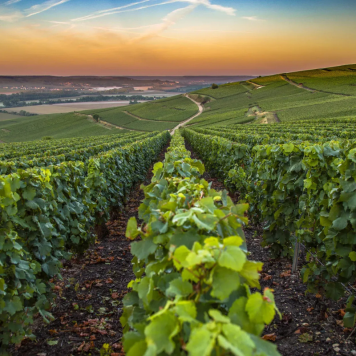
Montagne de Reims is one of Champagne's four main production areas, along with Côte des Blancs, Vallée de la Marne and Côte des Bar. The grape variety that has made the reputation of the Montagne de Reims is Pinot Noir, expressive, richly aromatic and complex.
Despite the powerful image that Pinot Noir has built for this wine-growing area, the black-skinned grape surprisingly accounts for only 41% of plantings. It shares the vineyards with 33% Meunier and 26% Chardonnay, which flourish better than Pinot Noir in some corners of the region.
A vineyard area of around 8,000 hectares, varying exposures and altitudes, and numerous soil formations create a rich diversity of styles in the different corners of the Montagne de Reims.
The main sub-areas of the Montagne de Reims are defined by different zones from north to south.

The Little Reims Mountain
Located to the west and south-west of Reims, the Petite Montagne area extends from Gueux in the west to Sermiers in the south-west. Vineyards in this area are mainly exposed to the northeast.
Meunier is the most widespread grape variety in this area, followed by Pinot Noir and small quantities of Chardonnay. The only exception is Bezannes, whose anecdotal vineyard of just 7 hectares is planted entirely with Chardonnay.
Soil formations differ from village to village, but many have clay and sand soils.
The Petite Montagne is home to 12 premier crus: Bezannes, Chambray, Coulommes-la-Montagne, Éceuil, Jouy-lès-Reims, Les-Mesneux, Pargny-les-Reims, Sacy, Sermier, Villedommange, Villers-aux-Noeuds and Vrigny.
Grande Montagne: the northern plateau
The northern part of the Grande Montagne de Reims stretches from Villers-Allerand - a village on the famous Route Nationale D951, which runs from Reims to Épernay - eastwards.
Eight Premiers Crus lie in the triangle between Villers-Allerand, the southeastern boundary of the city of Reims, and Ludes: Cormontreuil, Chigny-les-Roses, Ludes, Montbré, Rilly-la-Montagne, Taissy, Trois-Puits and Villers-Allerand.
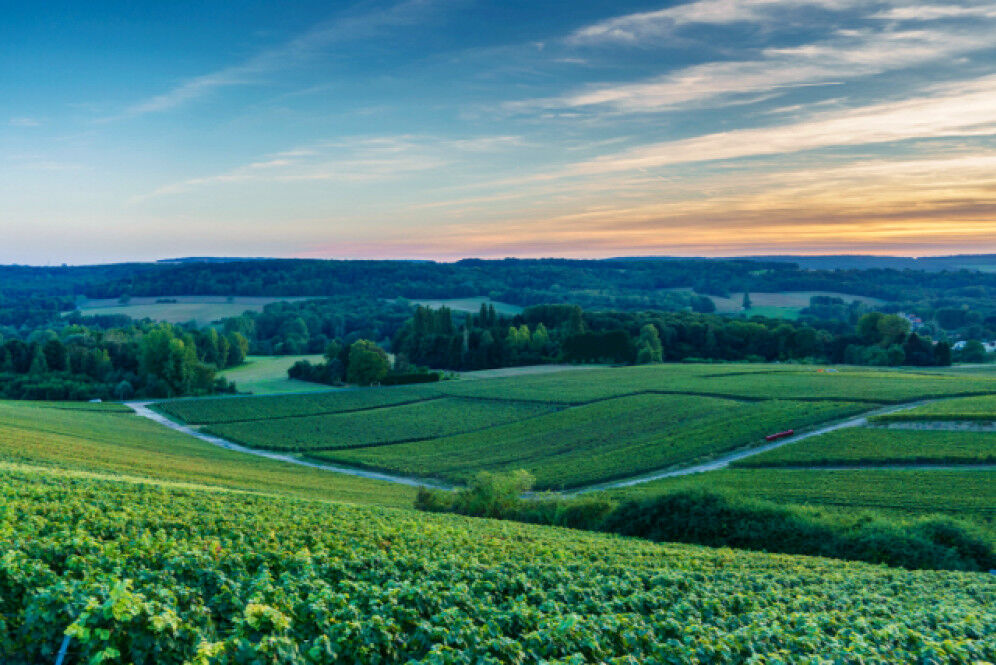
All the vineyards are planted on the northern slopes of the plateau, which explains why sun-loving Chardonnay generally ranks third behind Meunier and Pinot Noir (with a few exceptions, of course). Thanks to their northerly exposure, the wines from this region are remarkably fresh, with great finesse and delicate, supple fruitiness.
La Grande Montagne: the northeastern plateau
As you follow the road from Ludes towards the eastern flank of the plateau, the soils and exposure of the vineyards begin to change. Six Grands Crus are located on the northeastern flanks of the Grande Montagne de Reims: Mailly-Champagne, Puisieulx, Sillery, Verzenay, Beaumont-sur-Vesle and Verzy.
The hillsides with their limestone and marl-limestone subsoils - mixed with various deposits of eroded silt, sand or sandstone - offer favorable conditions for Pinot Noir, which accounts for most of the production here. The vineyards have different exposures - north, northwest and northeast. There is also a small proportion of Chardonnay in the vineyards, but Meunier is extremely rare.
Compared with wines from the southeastern slopes, grapes from the plateau's northeastern vineyards produce fresher, slightly spicy wines with intensity, length and structure.
La Grande Montagne: east of the plateau
At Villers-Marmery, the vineyards begin to extend southwards. Surrounded by vineyards dominated by Pinot-Noir, the villages of Villers-Marmery, Trépail, Billy-le-Grand and Vaudemange stand out for their almost exclusive cultivation of white-skinned grapes.
With its east-facing slopes, white chalk soils and protection from westerly winds, Chardonnay is well suited to this location.
The wines of Trépail and Villers-Marmery have a bold character combined with a well-balanced structure and a lively mineral freshness.
La Grande Montagne: the south-east of the plateau
Stretching southwards, the Montagne de Reims reaches its southernmost vineyards with the star crus Ambonnay and Bouzy, and descends to Tours-sur-Marne where it joins the Grande Vallée de la Marne.
Ambonnay, Bouzy, Louvois and Tours-sur-Marne are the famous Grands Crus of this area. Tours-sur-Marne has historically obtained Grand Cru status for Pinot Noir only, and Premier Cru status for Chardonnay.
The vineyards of Ambonnay and Bouzy, facing south and southeast, are planted with around 75% Pinot Noir and 25% Chardonnay. South-facing vineyards with limestone subsoil are generally reserved for Pinot Noir. With average temperatures slightly higher than in the northern part of the Montagne de Reims, harvesting generally begins a few days earlier.
Ambonnay's soils contain a thin layer of clay that brings out slightly more refined, spicy interpretations of these two powerful Pinot Noir terroirs, while Bouzy is known for its fuller-bodied intensity. In addition, over the course of history, both villages have become known for their rich, concentrated Coteaux Champenois red wines.
Compared to these two powerful Grand Crus, the Pinot Noir champagnes from Louvois and Tours-Sur-Marne, as well as the Premier Crus from Tauxières-Mutry, appear softer, fruitier and rounder, but also display notable depth.
Montagne de Reims blends:
- Champagne Besserat de Bellefon Blanc de Noirs Grand Cru
- Champagne Soutiran Grand Cru 2015
- Champagne Benoît Lahaye Violaine 2015
Single-village cuvées to discover :
- Ambonnay: Champagne Egly-Ouriet Grand Cru Les Crayères Blanc de Noirs Vieilles Vignes, or a Coteaux Champenois Ambonnay Rouge 2018
- Bouzy: Champagne Duval-Leroy Bouzy 2007
- Ludes: Champagne Cattier Clos du Moulin
- Mailly: Champagne Mailly Grand Cru L'Intemporelle 2012 or Champagne Mailly Grand Cru L'Intemporelle Rosé 2009, or Champagne Mailly Grand Cru Les Echansons 2012
- Verzenay: Champagne Lombard Verzenay Grand Cru or Grand Cru Verzenay Lieu-dit "Les Corettes".
- Vrigny: Champagne Egly-Ouriet Les Vignes de Vrigny
If you'd like to find out more about Champagne crus, we recommend this article.