Salomé Bastié, when didthe story of the Beaumont-des-Crayères cooperative begin?
In 1955, with a group of winegrowers who wanted to get together, showcase their exceptional terroir and create an independent, committed company to market their wines.Even today, we have several generations of children and grandchildren of the original members.At present, we have 230 members, some of whom work on the side or are retired, representing a total of between 70 and 80 hectares of vines. The surface areas vary from member to member: some have 5 ares, others 5 hectares, spread over Epernay, Damery, Cumières, Hautvillers and Dizy, as well as Pierry, Vinay and Epernay...
Where does the name "Beaumont des Crayères " come from?
Beaumont is the name of one of the most beautiful hillsides we own in the commune of Mardeuil, and crayères stands for the chalky soils of the Marne valley.
Your flagship grape variety is Meunier. How do you work with it?
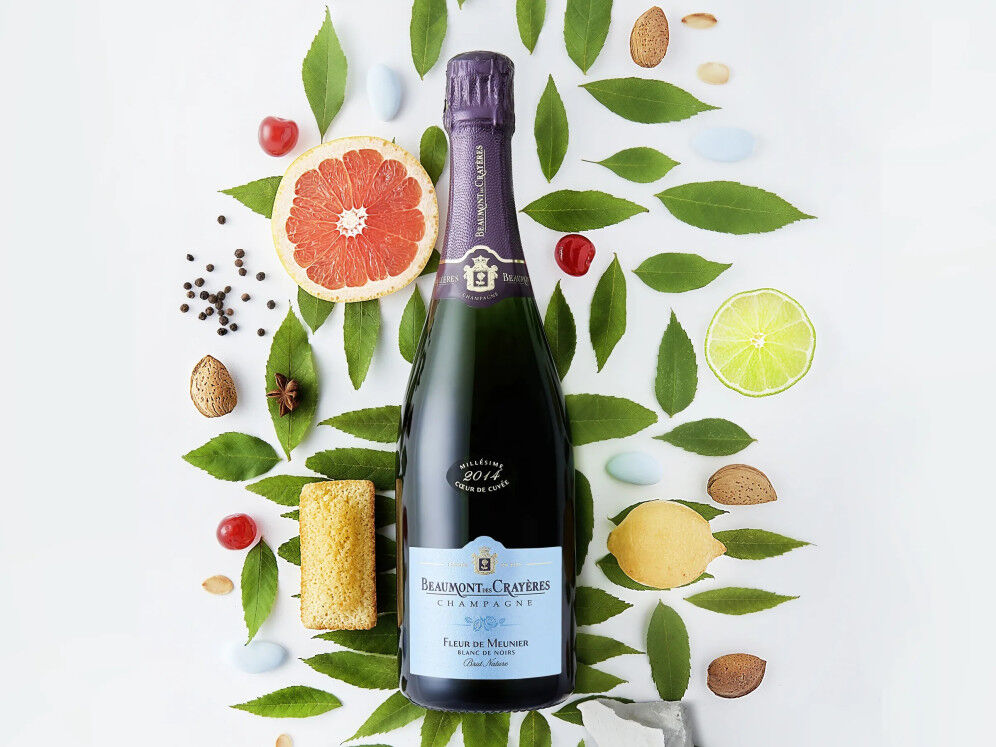
We've developed our know-how around this grape variety.Meunier is the grape variety we use most in all our blends, as well as a 100% Meunier cuvée. Meunier because in the Marne valley, it's the grape variety that's particularly common.
How many champagne ranges do you have at Beaumont-des-crayères?
We have two ranges with a total of 13 cuvées.The "Les Grands" range with 5 cuvées and the "Les Fleurs" range with 4 cuvées.We also produce 2 limited editions (a rosé and a brut) and 2 other prestige cuvées. The 1999, destined above all for Japan, and 1998, cuvées from the Private Collection.
Do you produce an organic cuvée?
No, we don't produce a specially organic cuvée, but we do offer our members HVE (Haute valeur Environnementale) and VDC (Viticulture Durable en Champagne) certification via our viticultural department.Certified vines will of course be valued more highly than those that are not. This is very recent, we launched this service in January 2021. The aim is to guide them as best we can towards these environmental approaches.
Do you have a wine-growing service within the cooperative?
We offer members who don't have the possibility to do so, to look after their vines for them. They remain the owners, of course, but we monitor the development of the vines, the grapes, the pruning and the entire vineyard. It's interesting for us, because we get to see more than "just" the grapes arriving after the harvest. We also offer other services, such as conversion to more sustainable farming methods.
Are there any members already interested in converting to organic farming?
Yes, some members have already taken the plunge.Some of them are more cautious, because it also means major costs for them, but we're working on it because we know that, little by little, this type of farming will become compulsory.The fact that they're not alone also helps them get over this hurdle.
On the "Les Fleurs" range, all the vintages are 100% "cœur de cuvée", can you explain what that means?
When we press the grapes just after the harvest, there's the first press, so the first juice is a juice with brighter aromas. The heart of the cuvée is the 2nd juice, with rounder, nobler, more sought-after aromas, to get to the real heart of the grape.
Les Fleurs" champagnes are aged for a minimum of 5 years. Is this a mandatory rule?
It depends on the vintage.Our cellar master, before releasing a vintage, will taste it, and depending on what he thinks best reflects the image of the house, will release it or wait another year or two. He could very well release a 2014 before a 2013 if that seemed to make the most sense.