
Champagne is a dessert wine....
Since the 19th century, both in France and abroad, Champagne wine has been enjoyed with dessert - it's true, because it's used to toast, among other things.
If you want to continue this tradition, you can offer your guests a few judicious pairings, such as a Champagne Rosé on a red fruit tart, or a Champagne Demi-Sec, much sweeter than Brut, on a Christmas cookie with mandarin confit, for example.
Discover our Champagnes Rosés andour Demi-Sec Champagnes
If you opt for a chocolate dessert, you'll need to be careful to find the right balance. If the Champagne dominates the chocolate, the latter will fade away. Conversely, if the chocolate is too prominent on the palate, the Champagne's aromas are neutralized. Dark chocolate from Madagascar is a perfect match for an old Champagne wine with restrained acidity. If you're not a fan of old Millésimés, go for Ratafia. This exceptional liqueur, whose name derives from the Latin expression "pax rata fiat", "peace is made", goes wonderfully well with chocolate.
Discover our Champagnes Millésimés
...aperitif
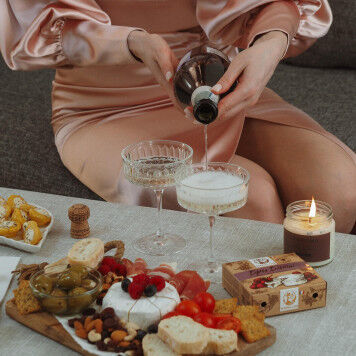
Over the years, Champagne has become a must-have for aperitifs, as it opens the appetite without saturating the palate. Extra-Brut and Brut Nature Champagnes are particularly recommended to awaken the taste buds. They can be served with fresh appetizers such as raw fish, shrimp or grilled shellfish. Classic aperitif accompaniments, such as peanuts, roasted almonds and other dried fruits, olives, potato chips... with their very distinctive flavors (salty, smoky, fatty) are to be avoided, as they cannot enhance the subtle, delicate aromas of Champagne wines.
Discover our Extra-Brut and Brut Nature Champagnes
...but not only!
At Envie de Champ', we also preach effervescence at the table throughout the meal. Louis Vaudable, famous for having owned the famous "Maxim's", never tires of reminding us that Champagne is a wine that goes with every dish.
Be careful, however, with the order of wines. There are a few rules to follow. Young wines should be served before older ones, brut wines before sweeter ones, lighter wines before stronger ones, and so on. In this way, you can fully savor the aromas of each Champagne wine.
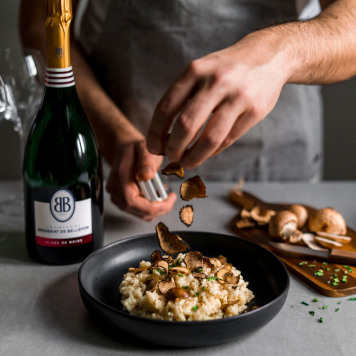
If you're serving a starter based on shellfish or raw fish, such as a platter of oysters or seafood, smoked salmon or fish tartar, choose a Champagne Blanc de blancs with a low dosage, as iodine and sugar don't mix.
Discover our Blanc de blancs Champagnes
Poultry and game are best served with a Champagne Millésimé or Blanc de noirs made from Pinot Noir and Meunier grapes, and red meats with a Champagne Rosé.
Discover our Blanc de noirs Champagnes
As for cheese...
Goat's cheese, semi-hard cheeses such as Saint-Paulin, tommes, Reblochon and hard, dry cheeses (Comté, Emmental). The great brut vintages are absolutely exquisite with ashy cheeses.
In short, Champagne, unlike Burgundy or Bordeaux, leads the party. Choose your Champagne wines and build your menu around them. From the very first glass, it will set the tone which, depending on the circumstances, will be one of confidence, joviality, even intellectuality, as it leaves the head free and the body light.
The only watchword is to enjoy yourself!
Cheers! And see you soon for more news!